

defermi#
Python library for the analysis and visualization of point defects. Simple and intuitive for new users and non-experts, flexible and customizable for power users.
UI#


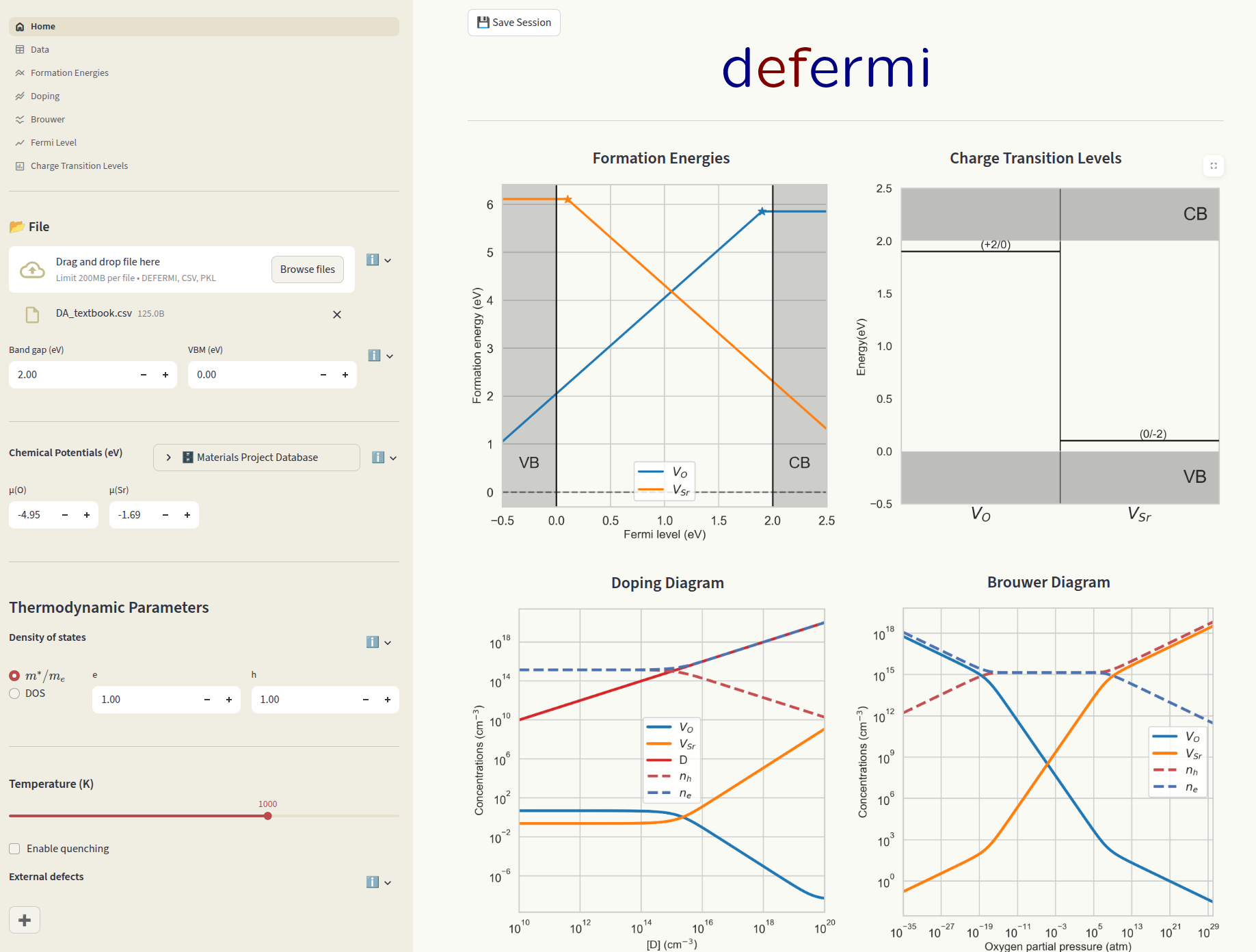
The library comes with a simple and intuitive graphical user interface. It runs in the browser without installation at: https://defermi.streamlit.app/
Features#
Formation energies: Easily calculate and plot formation energies of point defects.
Charge transition levels: Compute and visualize defect thermodynamic transition levels.
Chemical potentials: Generate, analyse and visualize datasets of chemical potentials. Automated workflow for datasets generations based on oxygen partial pressures.
Defect complexes: Support for defect complexes is included.
Equilibrium Fermi level: Compute the Fermi level dictated by charge neutrality self-consistently.
Brouwer and doping diagrams: Automatic generation of Brouwer diagrams and doping diagrams.
Temperature-dependent formation energies and defect concentrations: System-specific temperature-dependence of formation energies and defect concentrations can be included and customized.
Extended frozen defects approach: Calculate Fermi level under non-equilibrium conditions, fixing defect concentrations to target values while allowing charge to equilibrate. Useful for quenched conditions, extrinsic defects, partial quenching, and elemental concentration constraints.
Finite-size corrections: Compute charge corrections (FNV and eFNV schemes), currently for
VASPusingpymatgen.Automatic import from VASP calculations: Import datasets directly from VASP calculation folders. Support for
gpawcoming soon.
Overview#
Intuitive: All main functionalities are wrapped in the
DefectsAnalysisclass — no need to dig through deep documentation.Easy interface: Works with simple objects (
list,dict,DataFrame). Getting started is as easy as loading acsvfile.Flexible: Power users can customize every step; routines are available individually for full control.
Customizable: Users can supply their own formation-energy and concentration models, including temperature/volume dependence and system-specific behaviors.